Why, Do You Know, Why Reasons

Do you know the 'why' reasons, or, do the 'whys' often bother you for scientific explanations? For instance, you do know that stars twinkle, but do you know the reasons why, and how? Or, do you know the 'why' reasons behind falling in love? Or, do you know the reasons why dogs bury bones? Probably many of you don’t! Why Corner – the 'why' blog, answers these 'whys' for basic knowledge, with real reasons for the 'why' facts. So, just know them all here if you have the 'why' urge, that is!
Showing posts with label insects. Show all posts

Jul 21, 2008

Do you know why bees lose their buzz?

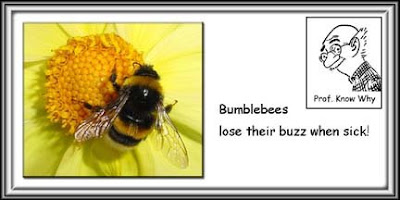
Bees lose their buzz

Prof. Know Why answers for your general knowledge and awareness on: Do you know why bees lose their buzz?

Like humans, the insect world also experiences problem in performing their routine jobs, when sick. Bumblebees lose a bit of their buzz when ill, and like humans, have a tougher time doing daily tasks until they recover, according to British researchers who reported their findings in the Royal Society's journal, Biology Letters, last week.

Evolutionary biologist Eamonn Mallon of the University of Leicester, who believes his findings can boost the efforts in saving dwindling bee colonies, said Honeybees with activated immune systems also have memory problems. He said that bees live on their memory. And, "If even a minor infection hurts its memory that is a major cost."

Like humans, bees can get sick and recover in days from infections after the immune system kicks into action to fight off viruses or parasites, Mallon said.

The researchers divided bees into two groups and injected half with a substance that stimulated the immune system. They then offered the bees the choice of blue and yellow flowers but only one color contained sugar water.

Eventually all the bees spent their time feeding from the correct flower but it took the stimulated bees 10 percent longer to reach this point, showing that an active immune response when ill affects memory, the researchers said.

In the past 50 years different kind of bee species and their population have become sparse day by day throughout the world and several are under threat. Scientists believe, apart from the farming methods that have deprived bumblebees of many traditional flowering plant food sources, diseases may help explain the decline.

Well, this can lead to serious concern about both the decline in wild bumblebee species and the effects of disease on the honeybee industry, of course if you care to give your ears!

Related Why Answers:

Bookmark and Share

Apr 21, 2008

Do you know why pollution keeps away bees from pollinating?

Prof. Know Why answers for your general knowledge and awareness:

Have you noticed lately that insects like bees and butterflies are gradually fading away in your neighborhoods? In a recent study, scientists found out why these wild populations of some pollinators, mainly bees, which need nectar for food, are fading in several areas of the world.

Researchers at the University of Virginia have shown that air pollution from power plants and automobiles is wiping out the fragrance of flowers and thus hampering the ability of bees and other pollinating insects to track scent trails to their source.

"The scent molecules produced by flowers in a less polluted environment, such as in the 1800s, could travel for roughly 1,000 to 1,200 meters; but in today's polluted environment downwind of major cites, they may travel only 200 to 300 meters," said Jose D. Fuentes, a professor of environmental sciences at the University of Virginia and a co-author of the study. "This makes it increasingly difficult for pollinators to locate the flowers," he added.

The result, potentially, is grave as bees and other pollinating insects like butterflies struggle to find sufficient food to keep up their populations and the flowering plants also do not get pollinated sufficiently to proliferate and diversify.

Other studies, as well as the actual experience of farmers, have shown that populations of bees, particularly bumblebees, and butterflies have declined greatly in recent years.

Researchers believe that air pollution, especially during the peak period of summer, may be a factor. To investigate this, they created a mathematical model of how the scents of flowers travel with the wind. They found the scent molecules, produced by flowers very volatile that quickly bond with pollutants such as ozone, hydroxyl and nitrate radicals, which destroy the aromas they produce.

This means that instead of traveling intact for long distances with the wind, the scents are chemically altered and the flowers, in a sense, no longer smell like flowers. This forces pollinators to search farther and longer and possibly to rely more on sight and less on smell.

From the research study, it became evident that air pollution destroys the aroma of flowers, by as much as 90 percent from periods before automobiles and heavy industries came into existence, And the more air pollution there is in a region, the greater the destruction of the flower scents, and the less pollinating insects like bees to balance the ecosystem.

Related Why Answers:

Bookmark and Share

Sep 3, 2007

Do you know why mosquitoes bite certain people?

Prof. Know Why answers:

It’s strange, but amazingly true that mosquitoes may not bite all the people in the same place. And only a selective set of people may fall prey to these tiny blood suckers that put millions of lives at stake by spreading malaria - the most prevalent life-threatening disease in the world. Scientists have worked out the answers why and how mosquitoes make a beeline for certain people and leave others almost untouched.

Specific cells in one of the three organs that make up the mosquito’s nose are tuned to identify the different chemicals that make up human body odor. To the mosquito, some people’s sweat simply smells better than others because of the proportions of the carbon dioxide, octenol and other compounds that make up body odor. It’s those people who are most likely to be bitten.

Mosquitoes use three organs to smell and taste – a feathery antenna which can identify a wide range of different chemicals, a proboscis used for short range detection and the maxillary palp for longer range smelling.

Scientists have found that maxillary palp contains a series of highly specialized receptor cells used to detect the different components of human body odor. Professors of biological sciences believe, mosquitoes are good transmitters of malaria because they are extremely good at finding people to bite, and maxillary palps serve as the malaria mosquito’s long range detection system.

So, if you think you are the mosquito’s delight, better take care!

Related Post:

Bookmark and Share